SWITCH Training and Research Chair
SWITCH Training and Research Chair

- Missions and Partners
-
Chair Purpose and Missions
Led by the Civil Engineering Department at Polytech Clermont, SWITCH brings together Faculty Researchers in the field of bio-based concrete and the company CCB Greentech, which specializes in structural wood-concrete with a negative carbon footprint.
The SWITCH Chair aims to develop innovative low-carbon or even carbon-negative materials for the construction sector. These materials rely on local mineral and plant-based resources. Currently, many types of concrete exist, ranging from lightweight to high-performance concrete, with compositions and characteristics that depend on the intended applications.
One of the Chair's objectives is the development of a self-placing (self-consolidating) wood-concrete composite.
The SWITCH Chair consists of two components:
- A training component, focused on the decarbonization of construction concrete and the valorization of plant by-products through courses, projects, and site visits for Civil Engineering students during their three-year engineering cycle.
- A research component on the development of structural wood-concrete through a PhD thesis.
The SWITCH Chair also relies on Polytech Clermont's technology transfer and innovation platforms: MSGC and ECOGRAFIPartner
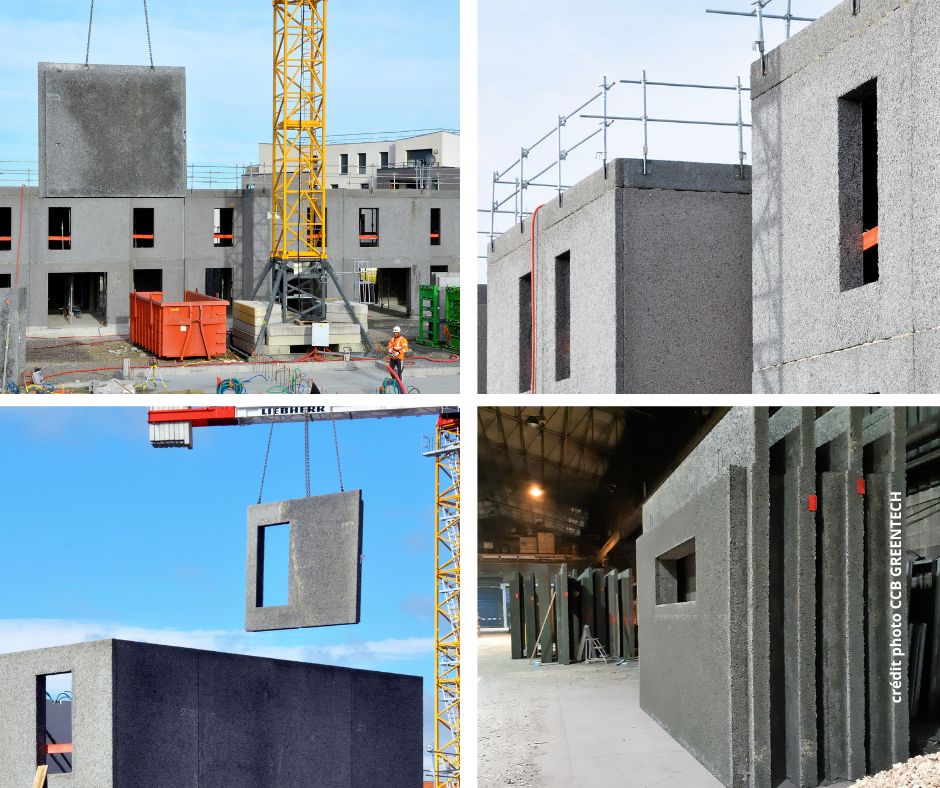
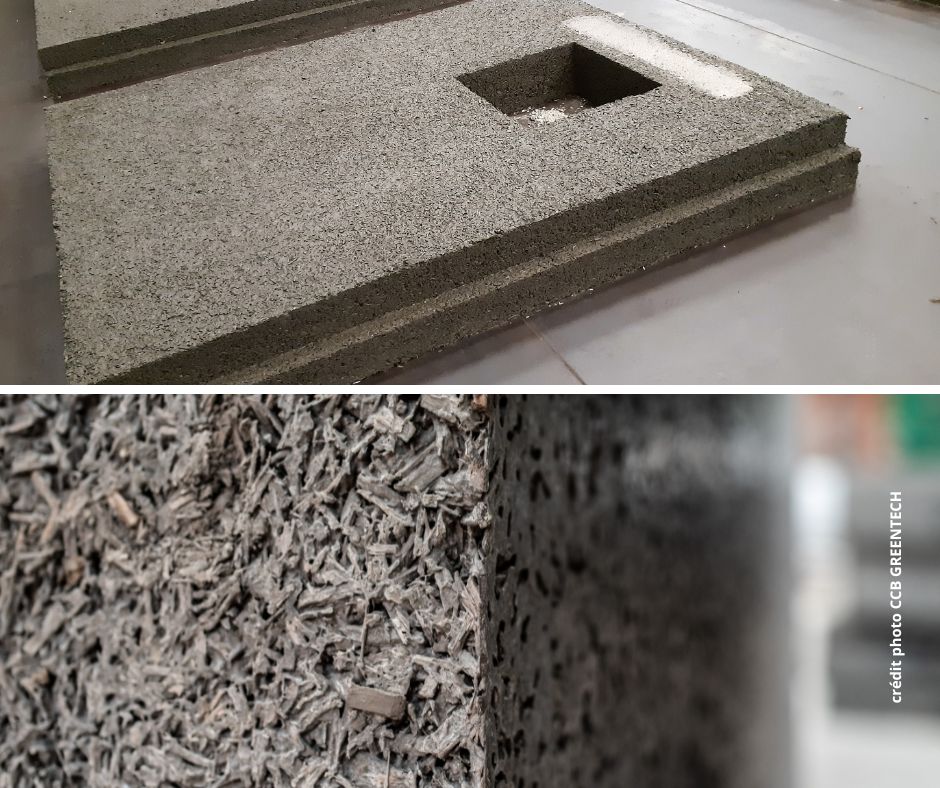
Thanks to 15 years of R&D, CCB Greentech has developed a construction material labeled as a "Bio-based Product": TimberRoc® wood-concrete. It has developed applications in patented construction principles for floors and walls (load-bearing or non-load-bearing up to 10 stories), marketed through licensed prefabrication partners. Its unique feature is a negative carbon footprint, certified by 5 FDES (Environmental and Health Declaration Sheets), and remarkable technical properties that perfectly address today's construction challenges: summer comfort, acoustic absorption, fire resistance, etc. Composed of 80% wood by volume and labeled "Bois de France," the wood-concrete contains high-quality wood aggregates produced from pulpwood mainly sourced from PEFC-certified forest operators.
CCB Greentech holds Case A ATEX (Technical Experimentation Assessments) for its various construction systems, allowing for the realization of all types of buildings in seismic zones 1 to 4.
Governing Bodies
- Research and Publications
-
Research
The 8 Research Axes:
1) Characterization of Raw Materials: The Polytech Clermont team specializes in the multi-physical characterization of plant-based aggregates: morphological characterization (3D grain distribution), water absorption, dust levels, physico-chemistry of aqueous phase leaching, acoustic characterization of aggregates, conductivity, effusivity, diffusivity, vapor permeability, heat capacity, porosity, etc.
2) Characterization of Wood-Concrete Composites: CCB GREENTECH possesses a unique technology for formulating a wood-concrete composite with exceptional mechanical, thermo-physical, and life-cycle properties. The collaboration aims to work on mixtures to push innovation further through formulation optimization. The goal is to invent Self-Placing Wood-Concrete. We also propose working on a better understanding of the aggregate/matrix interface. Indeed, it is at the ITZ (Interfacial Transition Zone) that mechanical and physical transfers occur. The quality of the material directly depends on the quality of the interface.
3) Qualification of the Serviceability Limit State (SLS) of Wood-Concrete: Current rules are based on a very conservative and sometimes arbitrary safety foundation. We therefore propose working on an original mechanical approach capable of providing a precise evaluation of the material to define its serviceability limit state. We will use established digital image correlation techniques combined with mechanical loading to detect the behavioral limit at which creep and irreversible deformations become problematic.
4) Comfort and Monitoring: One of the laboratory's specialties is the remote deployment of monitoring solutions and advanced simulation tools for building energy behavior. Simulations will be an effective tool to explain how to improve future buildings by providing target values for material properties.
5) Full-Scale Structural Tests: The laboratory has decades of experience in full-scale structural testing (https://msgc-cust.fr/equipements/). We can test all kinds of elements such as columns, beams, walls, and slabs under static, cyclic, or dynamic loads in flexion, push-over, compression, and shear. We possess specific expertise in structural dynamics.
6) Pervious Concrete: Beyond standard hydraulic permeability quantification, the laboratory has a test bench to qualify the thermal behavior of pavements under real and/or laboratory conditions.
7) FRCM: Reinforcement using plant-based textiles is a very promising path for creating reinforced wood-concrete using compatible solutions. The laboratory has the skills to study confinement reinforcement possibilities capable of significantly increasing mechanical performance with low-carbon solutions.
8) FIRE: Fire behavior is a specialty for a section of the laboratory located in Montluçon. We plan to study the fire protection of wood-concrete on the connection elements that may be included in the systems.
Publications
1- Bakkour, A., Ouldboukhitine, S. E., Biwole, P., & Amziane, S. (2025). Hygrothermal performance of wood-cement walls across various climate conditions. Materials and Structures, 58(1), 41. doi.org/10.1617/s11527-024-02560-224
2- Godchaux, A., Noca L., Coste, F., Toussaint, E., & Amziane, S. Characterization of the Elastic Modulus of Wood Concrete in Compression, Direct Tension, and Four-Point Bending Tension. Springer Nature Proceedings of ICBBM 2025, Rio de Janeiro, June 17–20, 2025. doi: under production.
Contacts
S. Amziane, Concrete Tests F1000 (Compression / Shear / Flexion), CCB Green Tech Company
S. Amziane, Concrete Compression Tests F800 (PRD Caroline Havart), CCB Green Tech Company
S. Amziane, Tests on DS1 and DS4 Wood-Concrete Slabs, CCB Greentech Company - News
-
April 2024: CCB Greentech site visit by the GC4 (Civil Engineering Year 4) cohort from Polytech Clermont
CCB Greentech Site Visit
Student Perspectives - Media Coverage
- CNRS Article - October 23, 2024
- Contact
-
Sofiane Amziane
Professor
- Gallery
-