
Interview with Nicolas Sauvat – A Study of the Timber from Notre-Dame de Paris
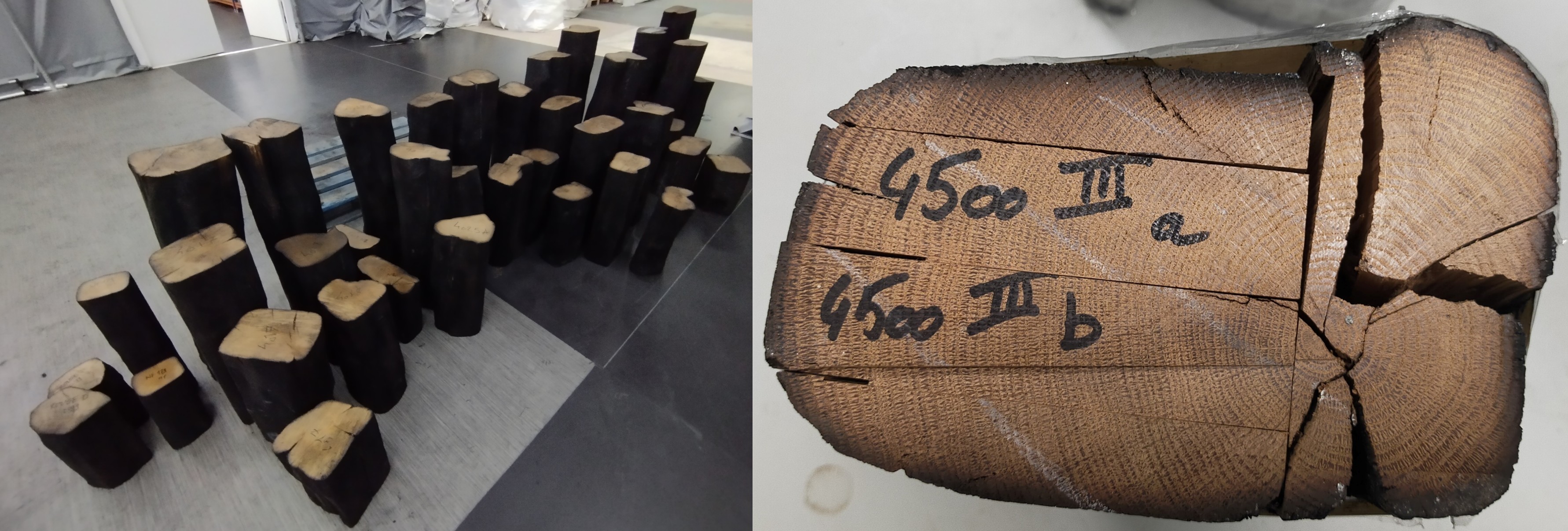
At Polytech Clermont, our faculty members contribute to major scientific projects, blending innovation and heritage preservation. We spoke with Nicolas Sauvat, Associate Professor at the Institut Pascal, who is involved in the study of the timber from Notre-Dame de Paris following the 2019 fire.
Introduction
Nicolas Sauvat, Associate Professor at Polytech Clermont and a member of the S2O team at the Institut Pascal laboratory, is contributing to the study of the oak timber used in the structural frame of Notre-Dame de Paris. This project aims to analyze the properties of this ancient wood for historical interest, but also to estimate the aging of the material's characteristics in order to establish rules for structural timber reuse.
Questions:
- Scientific context following the fire
The collapse of the structural frame of Notre-Dame following the 2019 fire made it possible to recover numerous remains from the original 12th and 13th-century framework, as well as later pieces related to repairs and the construction of the spire by Viollet-le-Duc in the 19th century. These "relics" have been dated and cataloged by archaeologist colleagues using dendrochronology. - Medieval framework
These studies confirmed that the medieval framework relied on the use of small-diameter oak wood, not sawn but simply squared (hewn), and most importantly, installed while green (unseasoned). This latter practice contrasts with modern structural engineering where wood drying is mandatory to ensure dimensional stability and mechanical behavior compatible with current design requirements. - Partnership
Along with my colleagues Joseph Gril and Rostand Moutou Pitti, we received support from the CNRS through the PEPS "FuturVieuxBois" project. We collected numerous samples and coordinated various studies with French and international partners. Cooperation is currently ongoing with the LMGC in Montpellier, Kyoto University in Japan, and the University of Florence in Italy. The goal is to compare the moisture, mechanical, and viscoelastic behavior of ancient and recent wood—in other words, understanding how ancient wood reacts to humidity or load compared to modern wood. - Challenges encountered
The main difficulty encountered in studying wood as a material is its natural variability. To quantify a possible alteration of properties over time, one must be able to estimate the reference state of the ancient wood. However, this depends on the original tree itself, its growth conditions, and the specific location in the trunk where the sample was taken—in short, everything that makes "Wood Science" so fascinating. - Impact of your research
The results of these measurements allow us to explore two avenues for further limiting the environmental impact of timber construction:
– Construction using green (unseasoned) wood is possible, even if it is more complex to ensure the long-term durability of structures. Yet, artificial wood drying is a highly energy-intensive step; if removed, it further reduces the environmental impact of structural timber. We are currently promoting this path through the Sapimac project, which aims to encourage the use of Silver Fir from the Massif Central.
– Studying wood that is 800, 400, or 200 years old helps us estimate the potential aging of the material, separate from mechanical damage. This estimation is crucial for defining evaluation rules for the reuse of structural timber components, in order to extend the service life within the material's life cycle and limit the depletion of resources.
This work illustrates how scientific research can contribute to heritage restoration while opening up perspectives for more sustainable construction. It is a source of great pride for Polytech Clermont and the Institut Pascal to participate in a project as symbolic as that of Notre-Dame.